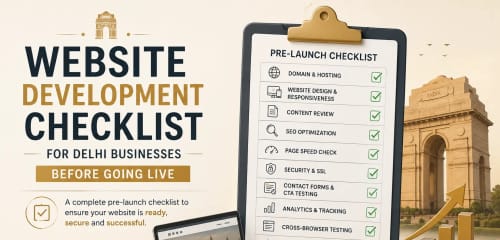


A professional website can help Delhi businesses attract customers, establish credibility, generate enquiries, and build a stronger online presence. In a competitive market, customers often compare several businesses before making a decision. A clear, fast, mobile-friendly website gives them a reliable place to understand your services, explore your expertise, and contact you.
A website is not simply an online brochure. It can become the foundation of your digital marketing strategy. Search visibility, social media campaigns, online advertising, content marketing, and customer enquiries can all lead visitors back to your website. When the website is planned around real customer needs, it can support business growth over the long term.
Why a Professional Website Matters for Delhi Businesses
Delhi has businesses operating across almost every industry, from restaurants and retail stores to consultants, healthcare providers, educational institutes, manufacturers, and professional service providers. Customers have plenty of options, which makes your online presentation important.
A professional website helps explain what your business offers without forcing potential customers to search across different platforms. Your homepage can introduce the business, service pages can explain specific offerings, and contact pages can make it easy for interested visitors to take the next step.
The website should also answer the questions customers commonly have. They may want to know where you operate, what services you provide, how the process works, what makes you different, and how they can contact you. When these details are easy to find, visitors can make decisions with greater confidence.
A modern business website should also include the right features to make the experience useful for visitors. Elements such as responsive design, clear navigation, security, contact options, and performance all contribute to website quality. For a detailed look at these elements, read “10 Essential Features Every Business Website Should Have in 2026.”
Builds Trust Before the First Conversation
Trust can start before a customer ever calls or sends a message. When people discover a business online, they may visit its website to decide whether the company appears reliable and professional.
A poorly organised website can create doubts. Outdated information, broken links, unclear services, low-quality images, or difficult navigation may cause visitors to leave. In contrast, a well-structured website gives customers a clear understanding of the business.
Professional presentation does not mean adding unnecessary animations or complicated features. The website should communicate important information clearly. The design, content, images, testimonials, service details, and contact information should support the same message.
Trust-building elements can include:
Clear business and service information
Updated phone, email, and location details
Customer reviews and testimonials
Relevant portfolio or project examples
Professional photographs and graphics
A useful About page
Easy-to-find enquiry options
These elements help reduce uncertainty and give potential customers more information before they decide to contact the business.
Helps Customers Find Your Business Through Search
A website can play an important role in search visibility. When someone searches for a product or service, search engines need to understand which pages are relevant to that query. A properly structured website gives them clearer information about the business, its services, and its areas of focus.
Search visibility should not be approached by repeatedly inserting keywords into every paragraph. Useful content is more valuable. A service provider can create dedicated pages that explain individual services, answer customer questions, discuss its process, and provide information that helps visitors make decisions.
The technical structure also matters. Logical navigation, descriptive page titles, relevant headings, internal links, mobile usability, and accessible content can help users and search engines understand the website.
For a Delhi business, this can create opportunities to reach people who are already searching for a specific solution. Someone looking for a service online may have stronger purchase intent than someone who simply comes across a business through a random social media post.
Creates a Strong Local Online Presence
Local customers often want to know whether a business serves their area. A website can communicate this information clearly while supporting the business's broader local presence.
For example, a Delhi service provider may genuinely serve areas such as Dwarka, Rohini, Janakpuri, South Delhi, West Delhi, or Central Delhi. Where relevant, the website can explain its service coverage and provide useful information for customers in those locations.
However, local content should not mean creating several pages with the same text and changing only the location name. Each page should have a genuine purpose and provide information that is useful to people in that area.
Consistent business information is also important. Your business name, contact details, services, and location information should remain accurate across your website and other online profiles. This creates a more consistent experience when customers discover your business through different channels.
Turns Website Visitors Into Potential Customers
Website traffic alone does not guarantee business growth. Visitors need a clear path towards taking action. Depending on the business, that action could be making a phone call, submitting an enquiry, booking an appointment, requesting a quotation, or purchasing a product. A service page, for example, can first explain the customer's problem, present the solution, demonstrate credibility, and then provide an enquiry option.
The conversion process should also be simple. A visitor should not have to search through several pages to find a phone number or contact form.
Useful conversion elements include:
Clear enquiry buttons
Short contact forms
Click-to-call functionality
Appointment or booking options
Product enquiry features
Relevant calls to action
The objective is not to pressure visitors. A good website gives people the information they need and makes the next step easy when they are ready.
Supports Digital Marketing Campaigns
A website gives businesses a central destination for different marketing activities. Search engine optimisation, social media, email campaigns, paid advertising, and content marketing can all direct users towards relevant website pages.
For example, a business may publish an informative article and share it on social media. A visitor who finds the article can then explore related services. Similarly, an advertising campaign can direct users to a dedicated landing page designed around a particular product or service.
This creates a connected marketing system instead of treating every digital channel separately.
A website can support campaigns through:
Service landing pages
Educational blog content
Lead-generation pages
Campaign-specific landing pages
Case studies
Product and service information
Over time, these assets can continue attracting and educating potential customers.
Improves the Customer Experience
Website development is not only about visual appearance. It is also about how easily visitors can find information and complete tasks.
A customer arriving on your website should understand where to go next. Simple navigation, readable content, clear page structures, responsive layouts, and visible contact options can make the journey easier.
Mobile usability is particularly important. Many customers use smartphones when searching for businesses, services, directions, or contact information. If the website is difficult to use on a smaller screen, potential customers may leave before they find what they need.
A mobile-friendly website should make important actions simple. Buttons should be easy to tap, text should remain readable, images should display correctly, and important information should not be hidden behind complicated navigation.
Gives Your Business More Control Over Its Brand
Social media platforms and third-party directories can help businesses reach customers, but businesses have limited control over how those platforms display information. Their layouts, algorithms, policies, and features can change.
A website gives your business its own digital space. You control the structure, branding, messaging, service information, images, navigation, and customer journey.
This is valuable for long-term brand building. As the business grows, new services can be added, successful projects can become case studies, and useful customer questions can become educational content.
A consistent website can also strengthen branding across other channels. The same visual identity and messaging can be used across social media, advertising, email campaigns, presentations, and offline marketing.
Makes It Easier to Showcase Expertise
Customers do not always make decisions based only on price. They may also consider experience, knowledge, previous work, service quality, and the business's understanding of their requirements.
A website provides space to demonstrate this expertise. Businesses can publish detailed service pages, case studies, project examples, guides, FAQs, and educational resources.
This is particularly useful for professional service businesses. A consultant, developer, designer, lawyer, marketer, or other specialist often needs to establish credibility before a customer is ready to make contact.
Instead of simply saying that your business is experienced, the website can explain how that experience benefits customers. Examples, processes, results, and practical information can make the message more convincing.
Helps Businesses Understand Their Audience
A website can also provide useful insights into visitor behaviour. Analytics tools can help businesses understand where visitors come from, which pages attract attention, how people navigate the site, and where they leave.
These insights can support future improvements.
For example, a service page may attract substantial organic traffic but receive very few enquiries. That could indicate an opportunity to improve the content, page structure, calls to action, or customer journey.
Similarly, if visitors frequently engage with a particular topic, the business can create additional content around that subject. This allows the website to evolve according to actual user behaviour rather than assumptions.
Website development should therefore be considered an ongoing process. Launching the website is the beginning of its digital journey, not necessarily the end.
Why Mobile-Friendly Design Is Essential
A modern website needs to work properly across smartphones, tablets, laptops, and desktop computers. Responsive design allows the layout to adapt to different screen sizes while keeping the content accessible.
This matters because customers may search for a business while travelling, during a work break, or from a mobile device at home. They may need quick access to a phone number, location, service information, or enquiry form.
A mobile-friendly website should provide:
Readable text without unnecessary zooming
Easy-to-use navigation
Touch-friendly buttons
Properly scaled images
Accessible contact information
Fast and stable page loading
Mobile usability improves convenience and helps visitors focus on the information they actually need.
Website Performance Can Affect User Engagement
Visitors expect websites to load and respond quickly. Slow pages can create frustration and may cause users to leave before interacting with the content.
Performance can be influenced by hosting, image sizes, scripts, caching, code quality, and the overall website architecture. Developers should consider performance during the planning and development stages rather than treating it as an afterthought.
A technically sound website can also be easier to maintain. Clean development practices, appropriate security measures, sensible page structures, and regular updates help reduce avoidable technical issues.
The purpose of performance optimisation is simple: users should be able to access important information without unnecessary delays.
A Website Can Support Long-Term Business Growth
A professional website should be treated as a long-term business asset. It can support customer acquisition, branding, content marketing, search visibility, lead generation, and customer education.
As a company grows, its website can grow with it. New services can receive dedicated pages, new projects can become case studies, and frequently asked questions can become useful resources.
This flexibility makes a website different from a short-term advertising campaign. A useful page can continue attracting visitors long after it has been published.
For Delhi businesses, this can create a strong digital foundation. Marketing campaigns can send visitors to dedicated pages, search traffic can discover informative content, and potential customers can research the business before making contact.
How to Choose the Right Website Development Partner
The quality of a website depends heavily on the development process. Businesses should look beyond visual design and evaluate whether a developer understands usability, performance, security, mobile responsiveness, content structure, and business objectives.
The right development partner should first understand the business and its audience. A restaurant, ecommerce store, law firm, healthcare practice, consultant, and B2B company will have different website requirements.
Businesses should consider:
Relevant development experience
Previous projects and portfolio quality
Responsive website capabilities
Technology and CMS expertise
Website speed and performance practices
Security and maintenance support
SEO-friendly website structure
Communication and project management
Post-launch support
Before hiring a developer, it is also important to compare proposals carefully. Scope, technology, timelines, support, deliverables, and costs can vary significantly between providers.
For businesses searching for a reliable Website Development Company in Delhi NCR, the focus should be on finding a development partner that understands both technology and business goals. A visually attractive website is useful, but it should also be easy to use, maintain, and expand.
Building Business-Focused Websites with Kreeya Design
At Kreeya Design, the focus is on creating websites that support real business objectives rather than simply looking attractive. A business website should make it easy for visitors to understand the services, find important information, and take the next step. The development process therefore starts by understanding the business, its audience, services, competitors, and long-term goals.
The website structure is then planned around the customer's journey. The homepage introduces the business, service pages explain individual offerings, and supporting content answers common questions that potential customers may have. This approach helps create a website that is organised, useful, and easier to navigate.
Choosing the right development approach is also important because proposals can differ in scope, technology, timelines, deliverables, and support. Businesses should not select a developer based only on the lowest quotation. They should understand exactly what is included and whether the proposed solution matches their requirements.
For a detailed understanding of what to evaluate before making a decision, read “How to Compare Website Development Proposals Before Hiring a Developer.” The guide can help businesses assess important areas such as project scope, technology, timeline, support, and overall value before selecting a development partner.
Kreeya Design also focuses on building websites with responsive design, usability, performance, security, and future scalability in mind. This allows the website to remain useful as the business grows and new services, content, campaigns, or features are introduced.
The objective is simple: create a website that works as a practical business asset. Instead of treating development as a one-time design project, the focus is on creating a digital foundation that can support customer engagement, marketing activities, enquiries, and long-term online growth.
Final Thoughts
A professional website can give Delhi businesses a stronger foundation for online growth. It can help build trust, improve the customer experience, support search visibility, generate enquiries, showcase expertise, and connect different marketing activities.
The most effective website is not necessarily the one with the largest number of features. It is the one that makes the business easy to understand, easy to navigate, and easy to contact.
When design, content, technology, performance, and business objectives work together, a website becomes more than an online brochure. It becomes a practical business asset that can continue supporting visibility, customer acquisition, and growth.
For businesses planning to strengthen their online presence, investing in the right website strategy and development process can create value well beyond the initial launch. A clear, useful, and customer-focused website gives Delhi businesses a stronger platform from which to grow online